
McGill Libraries
McLennan Library Building3459 rue McTavish
Montreal, Quebec
H3A 0C9

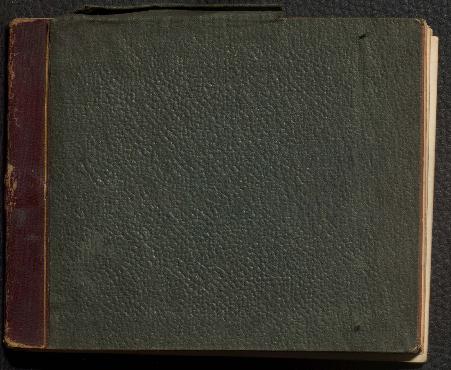
1 bound sketchbook (60 unnumbered pages) ; 11.5 x 14.5 cm
Note : Includes 23 sketches
Walter Crane was born on August 15 1845 in Liverpool, Lancashire England. His parents Thomas Crane (1808–59) and Marie Crane (née Kearsley) fostered an interest in the visual and literary arts in their four children. His father was a miniaturist and portraitist artist whose evening sketchclub encouraged Crane to set pencil to paper. By the age of thirteen the Cranes had moved to London where Walter Crane was able to show his illustrated to the art critic John Ruskin and the master engraver W.J. Linton. Between 1858 and 1862 Crane apprenticed under Linton--gaining experience in designing illustration for the printing process
Initiating his claim to fame as an illustrator, in 1863 Crane met the printer and entrepreneur Edmund Evans (1826-1905). The collaboration between printer and artist began in 1864 with the coloured covers for cheap railway novels. Evans pioneering work in coloured printing led to the cover-to-cover picture books that made Walter Crane alongside Kate Greenaway, and Randolph Caldecott best known as a children’s book illustrators. Between 1865 and 1886 Crane illustrated at least 48 titles for the children’s book market, many of which were reissued within the period. Crane’s illustrations for fairy tales and nursery rhymes fused together a range of influences from Japanese printing techniques, Pre-raphaelite aesthetics, and the figures in political cartoons.
Crane became a politically-conscious artist and a committed socialist, much like his friend and colleague William Morris whom he had met for the first time in 1870. Crane joined Morris in the Socialist League in 1884, and contributed illustrations to the league’s newspaper, The Commonweal. “Workers of the World Unite” exemplifies one of Crane’s many mottos. His often didactic socialist messages appear in a range of periodicals which also included Justice and The Clarion. Many of these illustrations were reproduced with additional drawings in Cartoons for the Cause, 1886-1896.
The Arts and Crafts Movement provided Crane with an avenue to develop his ideas on the potential unity between design and artistic labour. He contributed wall-paper and textile designs for Morris and Co, and produced illustrations for the Kelmscott Press, as well as a full scale panel paintings and friezes. As a leading member of this movement, Crane was a founder and president of the Art Workers’ Guild, and in 1888 founded the Arts and Crafts Exhibition Society
Crane had long sought out the power of aesthetics to teach the masses. Dedicated to teaching, Crane became art director as well as a teacher at the Manchester School of Art (1893–1896) and then of Reading College (1896–1898). He was principal of the Royal College of Art, South Kensington, London (1898–1899). During this later period Crane began to publish his teachings on such topics as the history of books, techniques of composition and design, and the socialist art of William Morris.
By the end of his prolific career Crane had contributed to range of artistic practices, namely: drawing, painting, book design, textile design,wallpaper panels, ceramics, and illustration. He had illustrated over a hundred fiction and non-fiction titles–several of which he also authored. His autobiographical recollections in An Artist’s Reminiscence, 1907, is one of his last major publications. The autobiography illustrates a cosmopolitanism that had been part of Crane’s life as an artist, craftsman, teacher, and socialist. Survived by three children, he died one year after his wife Mary Frances (née Andrews) on March 14, 1915, Horsham, Sussex.
This sketchbook points to Crane's political leanings, his view of the world, and his thoughts on labour and leisure. Bound in green cloth with gold embossed letters, the visual content tends towards the bucolic––featuring landscapes, sunsets, and a countryside cottage and imagery of animals. The pencil sketches include studies of birds––a solan geese, a black cock, and a cormorant. The absence of detail in the line drawings of cows and a horse rider on horseback contrast with the detailed studies of a cottage and rocks and shrubs.
Located near the end pages, the textual content includes hand-copied sections of written works by Charles Kingsley, John Ruskin, and Ralph Waldo Emerson. Copied in part, Kingsley poem titled Palinodia, 1841, which begins as an ode to nature, and continues as a commentary on mankind’s place in “sunless cities, and the weary haunts of smoke-grimed labour.” Crane also copied out sections of Ruskin’s essay, Unto the Last, 1860, which attacks aspects of classic economic theory associated with Adam Smith and John Stuart Mill. Excerpts from Ruskin are followed by Emerson’s History, from Essays: First Series, 1841.
The medium is pencil and ink on paper.
Pages torn from binding
[Potential applications for primary source activity:
Arts courses addressing the political, observing textual excerpts and images, and comparing finding: to what extent does the written and visual content illustrate Crane’s political leanings? ]
[Teachable Features Question for arts course addressing the political: To what extent does the written and visual content illustrate Crane’s political leanings? Begin by observing textual excerpts and images, and compare findings.]