
McGill Libraries
McLennan Library Building3459 rue McTavish
Montreal, Quebec
H3A 0C9
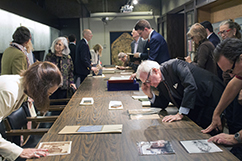
William Howard Feindel (1918-2014) was born in Bridgewater, Nova Scotia, to Annie MacKay and Robert Feindel. He graduated from Bridgetown High School in 1936 and received a Bachelor of Arts in Biology from Acadia University in 1939. In 1940, he received a Rhodes Scholarship to pursue an Honours in Physiology at Oxford University. Due to World War II, his scholarship was postponed, and he returned to Nova Scotia where he completed a Master of Science in Physiology at Dalhousie University (1942). He received his medical degree from McGill University (1945) and then returned to Oxford to complete the Rhodes Scholarship and received a degree in philosophy (neuroanatomy) (1949). In 1945, Feindel married Faith Dorothy Roswell Lyman and together they had six children: Christopher, Alexander, Patricia, Janet, Michael, and Anna.
In 1950, Feindel joined the Montreal Neurological Institute (MNI) and in 1959 became the first professor of the William Cone Laboratory for Neurosurgical Research and the first William Cone Professor of Neurosurgery. While at the MNI he worked with Wilder Penfield and Herbert H. Jasper to map temporal lobe seizures in the brain. In 1955, Feindel established the University of Saskatchewan’s neurosurgical unit. At the same time, under the direction of Harold Johns, Feindel and a team of physicists installed the first Canadian radioactive contour brain scanner. This complemented his work with Sylvia Fedoruk in devising a radioisotope method for measuring the brain’s circulation and his work with Joseph Stratford in introducing a decompressing technique used in neurosurgery.
From 1972 to 1984, Feindel served as the third director of the MNI, succeeding Theodore Brown Rasmussen and Penfield, respectively. After leaving the directorship in 1984 he became the director of the MNI’s Brain Imaging Centre. He also served on the Board of Governors of Acadia University and as Chancellor from 1991 to 1996. Between 1991 and 1996, Feindel took on administrative roles at Acadia University where he served on the Board of Governors and as the University’s Chancellor.
Feindel served as the co-literary executor and curator of Wilder Penfield's archives from 1976 until their transfer to the Osler Library for the History of Medicine in 2011. He also served as the director of the Neuro-History project. Throughout his academic career, Feindel sat on various student and professional boards, with positions including President of the Osler Society, President of the American Academy of Neurological Surgeons (1976), and the President of the Canadian Neurological Society (1978-1970). He was also coordinator of the Positron Emission Tomography research program at the MNI from 1975 to 1984.
Feindel received numerous awards for outstanding contributions to the field of medicine and neuroscience including: Fellow of the Royal Society of Canada (1973); Officer of the Order of Canada (1982); Grand Officer of the National Order of Quebec (2002); and member of the Canadian Medical Hall of Fame (2004) and L’Académie des Grand Montréalais (2004). Feindel also received honorary degrees from his alma mater, Acadia University (1963), as well as Mount Allison University (1983), McGill University (1984), and the University of Saskatchewan (1989).
Feindel authored more than four hundred research articles and numerous books on neurology, neurosurgery, and medical history. His work included research on the cubital tunnel in tardy ulnar palsy, the development of the first Canadian brain scanner for identifying tumors and strokes, and the installation of a positron emission tomography (PET) and subsequent clinical trials to examine cerebral circulation and epilepsy. The latter resulted in the integration of the Brain Imaging Centre (BIC) at the Montreal Neurological Institute. Feindel also produced historical works on Thomas Willis, including an edited version of “The Anatomy of the Brain and Nerves,” as well as on William Osler and Wilder Penfield. He also helped in the production of Penfield’s “No Man Alone: A Neurosurgeon’s Life” (1976) and headed the editorial committee for Pierre Gloor’s work “The Temporal Lobe and Limbic System” (1997).
This subseries contains William Feindel’s research on Thomas Willis. Included are materials related to events on Thomas Willis and documentation on a book Feindel edited on Willis.