Unbuilt projects.

Elements area

Taxonomy

Code

300126989

Scope note(s)

  • Refers to planned works of architecture that were never physically produced. For works other than architecture, use "unexecuted designs."

Source note(s)

  • Art & Architecture Thesaurus

Display note(s)

    Hierarchical terms

    Unbuilt projects.

      Equivalent terms

      Unbuilt projects.

      • UF Not Built

      Associated terms

      Unbuilt projects.

        70 Archival description results for Unbuilt projects.

        70 results directly related Exclude narrower terms
        CA CAC 58-1-90 · Subseries · between 1958 and 1961
        Part of Moshe Safdie

        Moshe Safdie's undergraduate thesis, "A Three-Dimensional Modular Building System," contains all of the concepts that would be realized in Habitat '67 at the World Exposition in Montreal. Officially titled "A Case for City Living," the thesis outlines Safdie's central premise: how can high-density urban housing include the amenities found in low-density suburban housing developments?

        The building system developed in the thesis combines three distinct concepts: an integrated three-dimensional urban structure, a construction system based on three-dimensional modules or boxes, and a system adaptable to a wide range of site conditions. The thesis explores three possible construction systems, applied to a community of 5000, each with its own structural system and geometry. In the first system (single repetitive module), a structural frame supports non-load-bearing, factory-produced modular units. In the second system (bearing-wall construction), the same modules are assembled in a load-bearing arrangement. In the third system (load-bearing module), prefabricated walls are arranged in a crisscross pattern.

        Overall the systems allow for flexibility, identity, privacy, community, and individual outdoor space. The modules may be stacked in many configurations to create a variety of housing types. The flexible arrangement allows for a complex in which no two dwellings are exactly alike and each can be recognized from the exterior. Because the modules are stacked on top of one another, walls and ceilings are doubled up, providing sound attenuation and privacy not achievable in conventional city-apartment high-rise construction. Modules are arranged in a staggered form, stepping back and allowing each roof to become an outdoor terrace for another dwelling. Pedestrian streets and vertical elevator and stair cores form the primary circulation systems. Finally, the modules are manufactured in a factory, lowering the individual-unit cost and allowing for relatively quick construction.

        Safdie Architects
        CA CAC 57-1-1.0 · File · [1979]
        Part of Arthur Erickson fonds

        File contains 6 drawings (3 site plans, 3 exterior perspectives), ink on bond, as well as 22 photographic prints of model. The medium density and medium rise residential community was planned for approximately 5,000 people in 900 units for average income families. The units were further subdivided into nine neighbourhood clusters containing 20 dwelling units sharing the circulation space and community facilities, such as schools, mosques, shops, recreation and open spaces. This density resulted in a stepped back building form that is eight storeys in height. The A-frame space provides a shaded and naturally ventilated inner street for community facilities in a richly landscaped setting. The project was not executed; the design and documentation were not completed

        The Cloisters
        CA CAC 28-8506 · File · 1985
        Part of John Schreiber Fonds

        File consists of 12 preliminary design drawings, 16 preliminary design sketches, 4 pages of text, and 1 project file under operation number 8510 (brochure).

        John Schreiber/Ron Williams Architects, Landscape Architects
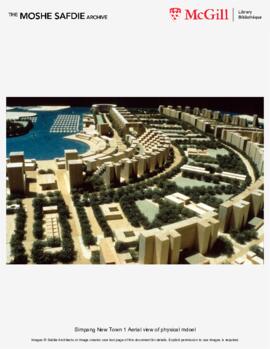
        Simpang New Town
        CA CAC 58-1-514 · Subseries · between 1992 and 1994
        Part of Moshe Safdie

        In this proposed new town of 125,000, commissioned by the Housing and Development Board of the Republic of Singapore, the repetitive housing typology model that maximizes density is re-examined. To break down the scale and maintain target densities, several housing typologies combine to create a hierarchy of massing that maximizes views and daylight exposures.

        These planning precepts incorporate a combination of high- and medium-density walk-ups with high-rise buildings, including terraced housing and clusters, to form urban windows that prevent the formation of solid walls along waterfront and park edges.

        Three principal main streets and a central linear park unite and orient the town. Streets and pedestrian paths run perpendicular to the park, where most social and educational services are located, bringing all dwellings into close walking and driving proximity to greenery, services, the town center, and the sea front. To capture views and take advantage of the city's natural edges, high-rise towers line the central park, the southern edge of town, and the waterfront. These design principles create a new and vibrant urbanism, celebrating the connection to the natural world with an organized set of networks and systems that serve diverse community activities and needs. Completed in 1994.

        Safdie Architects
        CA CAC 57-1-11.0 · File · 1981
        Part of Arthur Erickson fonds

        File includes 1 photograph print of mode. The SANCST Science Halls were conceived as a demonstration centre showing the development of science within the Muslim world, and making science accessible to all. The 125 hectare site was 12 km north of the Riyadh centre core. The entry was to be through a large semi-circular plaza from which both the Headquarters Building and the Science Halls could be accessed. The Headquarters Building possesses a strong central axis and the Science Halls are located near the far end of the site. The latter is set on an oblique angle giving it dual orientation. It also uses a strong system of Islamic geometric ordering, superimposition and the rotation of the basic square. The Science Halls have a traditional introverted character and the building mass sits on the Arabic landscape like a finite object, particularly in its use of natural materials. The exterior cladding is a warm colour of horizontally stratified Riyadh limestone with varying band depths. The important features of the Science Halls are the arrival plaza and its orientation, the souk street circulation, the laboratories, the demonstration theatres, the formal gardens, the traditional riverbed gardens, and the medicinal herb gardens.