Major project

Elements area

Taxonomy

Code

Scope note(s)

    Source note(s)

      Display note(s)

        Hierarchical terms

        Major project

          Equivalent terms

          Major project

            Associated terms

            Major project

              18 Archival description results for Major project

              18 results directly related Exclude narrower terms
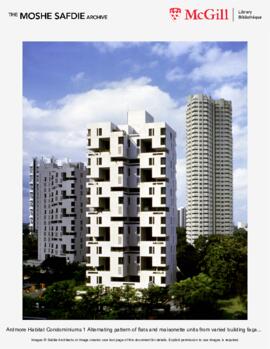
              Ardmore Habitat Condominiums
              CA CAC 58-1-293 · Subseries · between 1980 and 1985
              Part of Moshe Safdie

              The Ardmore Habitat Condominiums are situated in the heart of downtown Singapore, adjacent to the famed Orchard Road. The project consists of two 17-story towers of vertically stacked terraced units. The project was constructed by Robin Loh Enterprises, shipbuilders and developers, with the objective of providing the amenities of Habitat '67 to a constricted downtown site zoned for vertical massing.

              Both towers consist of alternating flat and two-story apartments, opening to a large outdoor garden. The two-story maisonettes are organized around an atrium, which extends to a large double-height external garden that serves as a visual and physical extension of the living area.

              Sizeable roof terraces extend the living area of each unit, strengthening the vertical and horizontal spatial experience. On the exterior this interplay manifests as an alternating pattern of flats and maisonette units, creating a multidirectional façade. Terraces wrap the corners of the towers, further articulating the elements of solid and void.

              The towers contain 61 middle income and luxury housing units, which are connected at ground level by landscaped recreation areas that include a swimming pool, squash courts, and gardens.

              Safdie Architects
              Ballet Opera House
              CA CAC 58-1-423 · Subseries · between 1987 and 1990
              Part of Moshe Safdie

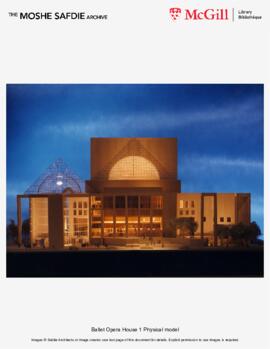
              The Ballet Opera House was planned as the home and performance center for the National Ballet of Canada and the Canadian Opera Company, located in downtown Toronto between Bay and Yonge Streets. When a new provincial government was elected, however, the project was indefinitely shelved pending resolution of funding issues. Safdie's design features a public passage, referred to as "Gallery of the Artists," traversing the site at street level and accommodating specialty retail elements. The heart of the project was to be a 2,000 seat auditorium consisting of a main stage and three support stages, while the exterior of the building was to be composed of a series of tower-like elements that integrated it with the surrounding streets of Toronto.

              Safdie Architects
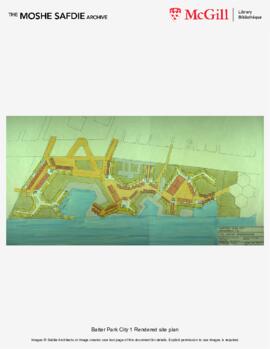
              Battery Park City
              CA CAC 58-1-174 · Subseries · 1972
              Part of Moshe Safdie

              Located along the Hudson River not far from the former World Trade Center, the project was envisioned to solve the city's housing shortage. The master plan accommodated affordable housing for approximately 400,000 people. Safdie's proposal included 14,100 apartments, several schools, a library, a hospital, and other amenities covering 91 36.4 ha. The prefabricated modular construction system was also explored for this project.

              Safdie Architects
              CA CAC 58-1-557 · Subseries · 1980 - 2015
              Part of Moshe Safdie

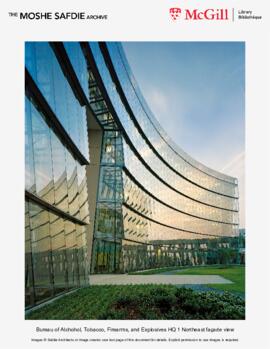
              The Alcohol, Tobacco, Firearms, and Explosives building serves as the national headquarters for a government agency with the highest security requirements. Located at the intersection of New York and Florida avenues, this building has been a catalyst for urban renewal and rejuvenation in the surrounding district. The program called for general office space, extensive training facilities, an auditorium, and auxiliary services.

              Notwithstanding security setback requirements, the complex engages and animates the surrounding street edges. The entrance is positioned across from the new Metro station on the southeast corner; retail facilities line 2nd Street (to the east); and a trellised garden wall defines N Street (to the south). In addition a three-story planted, arcaded crescent contains the site to the north and west, enclosing a 48,500-square-foot internal garden and inconspicuously serving as a security barrier.

              Auxiliary elements such as loading docks and an inspection booth are integrated into the overall fabric of buildings and garden walls. The provision of a technical subfloor for the distribution of data and mechanical services allows for maximum flexibility. The office space consists of relatively narrow floor plates surrounding a large atrium, thus affording daylight for all workspaces.

              Safdie Architects
              Callahan Residence
              CA CAC 58-1-258 · Subseries · between 1978 and 1981
              Part of Moshe Safdie

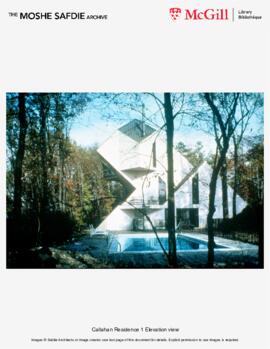
              Alston and Elivor Callahan owned a piece of property atop Red Mountain overlooking Birmingham, Alabama. The Callahans requested a house that would give them the sense of living in a control tower, similar to the one at Dulles Airport in Washington, DC, to overlook the city. Safdie's proposal comprised of a series of intersected cubes rotated at 45 degrees with the horizontal. The unique geometry with an elongated rectangular plan suited this unusual site. The design approach resulted in an extroverted yet transparent building that commands its surroundings.

              Safdie Architects
              Chongqing Villas
              CA CAC 58-1-xx · Subseries · 2012-2018
              Part of Moshe Safdie

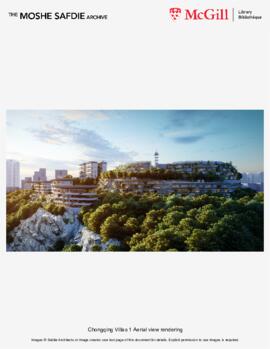
              Located on a broad hillside site adjacent to Chongqing’s well-known Eling Park, the design for the Eling Residences grows out of and echoes the dramatic natural topography of the site.

              The buildings are organized with terracing villa units climbing the rock slopes and stepping up to the crest of the hill where, along the ridge line, two dome-shaped structures overlook the city. The location and organization of the low-rise terraced buildings endows each of the 126 apartments with natural daylight and affords uninterrupted views of the Yuzhong Peninsula and the Yangtze River. Interwoven with the buildings is a lush landscape comprised of cascading gardens, terraces, overlooks, stairs, and promenades for the residents to enjoy.

              At the western edge of the site, a prominent 4-story clubhouse stands as a beacon for the project, signifying the entrance to both Eling Park and the development.

              The terraces of the hilltop units provide uninterrupted views to the Yangtze River and city beyond. Each terrace serves as an extension of the apartment, maximizing residents’ access to light and air. Planters are integrated along the length of the terraces, and climbing plants will grow up the trellises to provide additional shading.

              Safdie Architects
              Cité des Iles
              CA CAC 58-1-112 · Subseries · 1968
              Part of Moshe Safdie

              Cité des Iles was a study proposed to the City of Montreal by Moshe Safdie following the close of Expo '67. The overall idea behind the study was to transform the temporary Expo exhibition site including structures, parks, and transit lines into permanent amenities for the city. The study was well received by many city officials, but did not proceed because of anticipated review complications between the various levels of provincial, federal, and municipal agencies.

              Safdie Architects
              CA CAC 58-1-98 · Subseries · 1962
              Part of Moshe Safdie

              The city of Giza was a theoretical study for a high-density city, amidst the existing ancient pyramids, which could accommodate the resettlement of 250,000 Palestinian refugees. Giza illustrated a number of concepts which Moshe Safdie had been exploring prior to Habitat '67 such as workable high-density environments, three-dimensional reorganization of urban land uses, the organization of individual dwellings as spatial groupings, the hierarchical organization of transportation networks, and the utilization of mass-production construction techniques.

              Safdie Architects