Item 0001 - Letter, 9 June 1896

Open original Digital object

Title and statement of responsibility area

Title proper

Letter, 9 June 1896

General material designation

    Parallel title

    Other title information

    Title statements of responsibility

    Title notes

    • Source of title proper: Title based on content.

    Level of description

    Item

    Reference code

    CA MUA MG 1022-2-1-299-0001

    Edition area

    Edition statement

    Edition statement of responsibility

    Class of material specific details area

    Statement of scale (cartographic)

    Statement of projection (cartographic)

    Statement of coordinates (cartographic)

    Statement of scale (architectural)

    Issuing jurisdiction and denomination (philatelic)

    Dates of creation area

    Date(s)

    • 9 June 1896 (Creation)
      Creator
      Sayce, A. H. (Archibald Henry), 1845-1933
      Place
      Oxford (England)

    Physical description area

    Physical description

    Publisher's series area

    Title proper of publisher's series

    Parallel titles of publisher's series

    Other title information of publisher's series

    Statement of responsibility relating to publisher's series

    Numbering within publisher's series

    Note on publisher's series

    Archival description area

    Name of creator

    (1845-1933)

    Biographical history

    Archibald Henry Sayce was born on September 25, 1845, in Shirehampton, Bristol, Gloucestershire, England.

    He was a pioneer British Assyriologist and linguist. Despite frequent ill health as a child, he was a voracious reader, and by the age of 18, he taught himself to read some Ancient Egyptian, Sanskrit, and Hebrew and became interested in cuneiform. In 1865, he published his first academic paper, Cuneiform inscriptions of Van. He graduated from Queen's College, Oxford (B.A., 1869) and was elected a Fellow and Classical Lecturer. In 1870, he became a college tutor and was also ordained as a priest of the Church of England. In the early 1870s, Sayce was a regular weekly contributor to The Times and the New York Independent. In 1879, he resigned from his role as a college tutor to free up time for exploration and was instrumental in founding the Alexandria Museum in Cairo. In 1891, Sayce returned to Oxford to become the University's first Professor of Assyriology, a position he held until his retirement in 1915. He was the Hibbert (1887), Gifford (1900-1902) and Rhind Lecturer (1906) and travelled to Sudan, Ethiopia, and the Far East. He helped found the Society of Biblical Archaeology (1898-1919) and the Society for the Promotion of Hellenic Studies. After his retirement, Sayce continued to write and spent his time in Edinburgh, Oxford, and Egypt.

    He died unmarried on February 4, 1933, in Bath, Somerset, England.

    Custodial history

    Scope and content

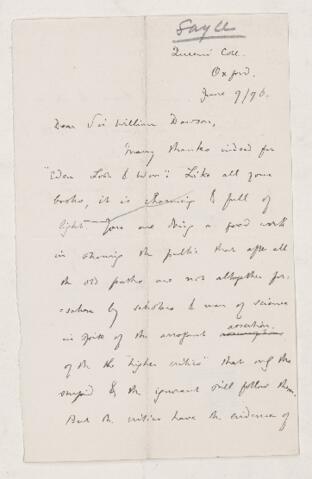
    Letter from A.H. Sayce to John William Dawson, written from Oxford.

    Notes area

    Physical condition

    Immediate source of acquisition

    Arrangement

    Language of material

      Script of material

        Location of originals

        Availability of other formats

        Restrictions on access

        Terms governing use, reproduction, and publication

        Finding aids

        Associated materials

        Related materials

        Accruals

        Alternative identifier(s)

        Accession no.

        1463/617

        Standard number

        Standard number

        Access points

        Subject access points

        Place access points

        Name access points

        Genre access points

        Control area

        Description record identifier

        Institution identifier

        Rules or conventions

        Status

        Level of detail

        Dates of creation, revision and deletion

        Language of description

          Script of description

            Sources

            Digital object (External URI) rights area

            Digital object (Reference) rights area

            Digital object (Thumbnail) rights area

            Accession area