
McGill Libraries
McLennan Library Building3459 rue McTavish
Montreal, Quebec
H3A 0C9
Sir John Alexander Macdonald was born on January 11, 1815, in Glasgow, Scotland.
He was the first prime minister of Canada (1867–1873, 1878–1891). In 1820, his family immigrated to Kingston, Ontario. He attended the Midland District Grammar School (1827–1828) and also a private co-educational school. In 1830, he began to article in the office of a Kingston lawyer George Mackenzie and in 1832, he was entrusted with the management of his branch office in Napanee. In 1835, he opened his own firm in Kingston and was called to the bar in 1836. As a lawyer, he quickly attracted public attention, mainly by taking on a number of difficult and even sensational cases. He was also an active businessman involved in land development and speculation. After the British Parliament united Upper and Lower Canada as Canada West (now Ontario) and Canada East (now Quebec) in the Act of Union of 1840, Macdonald was elected to the assembly of the Province of Canada as a Conservative for Kingston in 1844. In 1846, he was made a Queen's Counsel. His first experience as a cabinet member was in 1847–1848. In 1854, he became Attorney General for Upper Canada, a position he held until 1867 except for periods in 1858 and 1862–1864. He became prime minister of the Province of Canada in 1857. He worked at promoting the British America League, designed to unify Canada and strengthen its ties to Great Britain. In June 1864, Macdonald and Cartier joined with their chief opponent, George Brown, in order to further the scheme of the confederation of British North America. After conferences in Charlottetown, Prince Edward Island, in Quebec, and in London, the British North America Act was passed (1867), creating the Dominion of Canada, and Macdonald became its first leader. He was created Knight Commander of the Bath (KCB) in recognition of his services to the British Empire. Under his leadership, the dominion quickly expanded to include the provinces of Manitoba (1870), British Columbia (1871), and Prince Edward Island (1873). The Pacific Scandal of 1873, in which the government was accused of taking bribes in regard to the Pacific railway contract, forced Macdonald to resign, but he returned as prime minister five years later and served until his death. He was awarded honorary degrees from Queen's University at Kingston (1863), University of Oxford (1865), and University of Toronto (1889).
In 1843, he married Isabella Clark (1809-1857) and in 1867, he married Lady Agnes Bernard (1836-1920). He died on June 6, 1891, in Ottawa, Ontario.
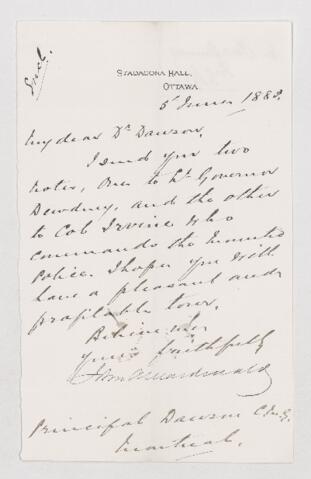
Letter from John A. Macdonald to John William Dawson, written from Ottawa.