
McGill Libraries
McLennan Library Building3459 rue McTavish
Montreal, Quebec
H3A 0C9
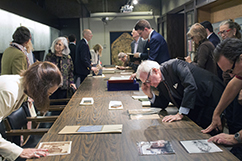
Bernard James Harrington, sometimes known as B.J., was born in 1848 in Saint Andrew’s (Saint-Andre-Est), Lower Canada, to which his great grandfather had immigrated from Massachusetts in 1805 and helped establish the first Canadian paper mill there. Poor eyesight meant that most of his early education was under private teachers, but he entered McGill University and graduated from there with a B.A. in Natural Science with first class honours in 1869 and obtained a doctorate in mineralogy with distinction from Yale’s Sheffield Scientific School in 1871, apparently the first Canadian to get a PhD from there. That summer he helped John William Dawson, McGill’s principal, with research on Prince Edward Island and then began his 36-year teaching career at McGill by lecturing in chemistry, mineralogy, and assaying. After also spending some time in Britain visiting smelting works in chief mining and manufacturing centres, he added metallurgy to the subjects he taught. In 1872, in addition to his teaching load, he was appointed as chemist and mineralogist to the Geological Survey of Canada (conveniently based in Montreal), a post he held till 1879. He received the David Greenshields chair of chemistry and mineralogy at McGill in 1883. Among his other responsibilities were as president of the Natural History Society of Montreal, and as president of the chemistry and physics section of the Royal Society of Canada in 1890. He is the author of a biography of Sir William E. Logan, the first director of the Canadian Geological Survey, and many scientific publications.
As for his personal life, in 1876, he married Anna Lois Dawson, daughter of McGill’s principal, and began a family, eventually to include nine children (Eric, Edith, William, Bernard, Ruth, Clare, Constance, Conrad and Lois), although two (Eric and Edith) died before adulthood. His modest salary as a professor meant that the family lived simply but with much help from the generosity of his father-in-law, who built them a house next to the campus in Walbrae Place where they lived until 1893 when Dawson bought a house at 293 University (now 3641) for himself and bought them another house next door. He also bought them a cottage next to Birkenshaw, his summer home in Little Metis.
Harrington was a lover of music, for which he had some talent: he was an editor and composer in the production of the McGill College Song Book (1885). His portrait by Robert Harris hangs in the MacDonald Chemistry Building, of which he was the first director from its opening in 1898 until his death in 1907.
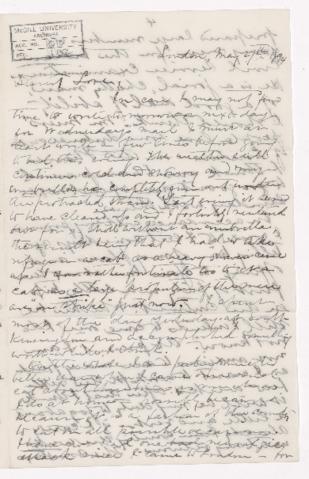
Letter from Bernard to Anna Harrington.