Item 0027 - Letter, 20 December 1886

Open original Digital object

Title and statement of responsibility area

Title proper

Letter, 20 December 1886

General material designation

    Parallel title

    Other title information

    Title statements of responsibility

    Title notes

    • Source of title proper: Title based on content.

    Level of description

    Item

    Reference code

    CA MUA MG 1022-2-1-226-0027

    Edition area

    Edition statement

    Edition statement of responsibility

    Class of material specific details area

    Statement of scale (cartographic)

    Statement of projection (cartographic)

    Statement of coordinates (cartographic)

    Statement of scale (architectural)

    Issuing jurisdiction and denomination (philatelic)

    Dates of creation area

    Date(s)

    • 20 December 1886 (Creation)
      Creator
      Hale, Horatio, 1817-1896
      Place
      Clinton (Ont.)

    Physical description area

    Physical description

    Publisher's series area

    Title proper of publisher's series

    Parallel titles of publisher's series

    Other title information of publisher's series

    Statement of responsibility relating to publisher's series

    Numbering within publisher's series

    Note on publisher's series

    Archival description area

    Name of creator

    (1817-1896)

    Biographical history

    Horatio Emmons Hale was born on May 3, 1817, in Newport, New Hampshire.

    He was an American-Canadian ethnologist, philologist, and businessman. Entering Harvard College in 1833, Hale showed a striking ability for languages. In 1834, he published his remarkable first original work consisting of an Algonkin vocabulary, which he gathered from Indians camping on the college grounds. From 1838 to 1842, he worked with the U.S. Exploring Expedition under Capt. Charles Wilkes of U.S. Navy, visiting South America, Australasia, Polynesia, and North-western America. He received his M.A. degree from Harvard, then studied law, and was admitted to the Chicago bar in 1855. In 1856, after a marriage to a Canadian, he moved to Clinton, Ontario, and began to get involved in local real estate development and other business and educational endeavours. He devoted much attention to the development of the Ontario school system and was influential in introducing co-education of the sexes in high schools and colleges, in increasing the grants to these institutions, in establishing the normal school system, and in improving the methods of examination. He discovered two Indian manuscripts, dating between 1714 and 1735; the only known literary American Indian work extant. In 1883, he published “The Iroquois Book of Rites”, which included his translated and edited versions of these papers. Hale’s judicious introductions, careful translation, and editing add much to the value of the work. He was also the first to identify the Cherokee language as a member of the Iroquoian family of languages. In 1872, he was elected as a member of the American Philosophical Society. He reorganized the section of anthropology as an independent department of the American and also British Association for the Advancement of Science. Hale was an honorary fellow of the Anthropological Institute of Great Britain.

    In 1854, he married Margaret Pugh (1834–1900). He died on December 28, 1896, in Clinton, Ontario.

    Custodial history

    Scope and content

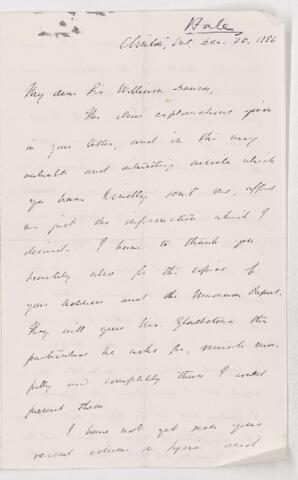
    Letter from H. Hale to John William Dawson, written from Clinton, Ontario.

    Notes area

    Physical condition

    Immediate source of acquisition

    Arrangement

    Language of material

      Script of material

        Location of originals

        Availability of other formats

        Restrictions on access

        Terms governing use, reproduction, and publication

        Finding aids

        Associated materials

        Related materials

        Accruals

        Alternative identifier(s)

        Standard number

        Standard number

        Access points

        Subject access points

        Place access points

        Name access points

        Genre access points

        Control area

        Description record identifier

        Institution identifier

        Rules or conventions

        Status

        Level of detail

        Dates of creation, revision and deletion

        Language of description

          Script of description

            Sources

            Digital object (External URI) rights area

            Digital object (Reference) rights area

            Digital object (Thumbnail) rights area

            Accession area