Item 0008 - Letter, 11 February 1869

Open original Digital object

Title and statement of responsibility area

Title proper

Letter, 11 February 1869

General material designation

    Parallel title

    Other title information

    Title statements of responsibility

    Title notes

    • Source of title proper: Title based on content.

    Level of description

    Item

    Reference code

    CA MUA MG 1022-2-1-038-0008

    Edition area

    Edition statement

    Edition statement of responsibility

    Class of material specific details area

    Statement of scale (cartographic)

    Statement of projection (cartographic)

    Statement of coordinates (cartographic)

    Statement of scale (architectural)

    Issuing jurisdiction and denomination (philatelic)

    Dates of creation area

    Date(s)

    • 11 February 1869 (Creation)
      Creator
      Cope, E. D. (Edward Drinker), 1840-1897
      Place
      Philadelphia (Pa.)

    Physical description area

    Physical description

    Publisher's series area

    Title proper of publisher's series

    Parallel titles of publisher's series

    Other title information of publisher's series

    Statement of responsibility relating to publisher's series

    Numbering within publisher's series

    Note on publisher's series

    Archival description area

    Name of creator

    (1840-1897)

    Biographical history

    Edward Drinker Cope was born on July 28, 1840, in Philadelphia, Pennsylvania.

    He was an American paleontologist and comparative anatomist, as well as a noted herpetologist and ichthyologist who discovered approximately a thousand species of extinct vertebrates in the United States and led a revival of Lamarckian evolutionary theory, based on paleontological views. After a brief period at Haverford College, Pennsylvania, as Professor of Comparative Zoology and Botany (1864–1867), Cope devoted 22 years to exploration and research. Most of this time was spent in the discovery and description of extinct fishes, reptiles, and mammals of the western United States, from Texas to Wyoming. In 1863–1864 during the American Civil War, Cope travelled through Europe, taking the opportunity to visit the most esteemed museums and societies of the time. He also served as a paleontologist with the U.S. Geological Survey and the editor and publisher of The American Naturalist. Financial difficulties compelled him to accept a position on the faculty of the University of Pennsylvania (1889–1897). Among his 1,200 books and papers are “Reptilia and Aves of North America” (1869–70) and “Relation of Man to Tertiary Mammalia” (1875). In 1872, he was made a member of the U. S. National Academy of Sciences and in 1878 of the Societé Géologique de France. The Bigsby gold medal of the Geological Society of London was awarded to him in 1879. In 1886, he was elected a member of the Imperial Society of Moscow and received the honorary degree of Doctor of Philosophy from the University of Heidelberg.

    In 1865, he married Annie Pim (1841-1933). He died on April 12, 1897, in Philadelphia, Pennsylvania. He donated his body to scientific research.

    Custodial history

    Scope and content

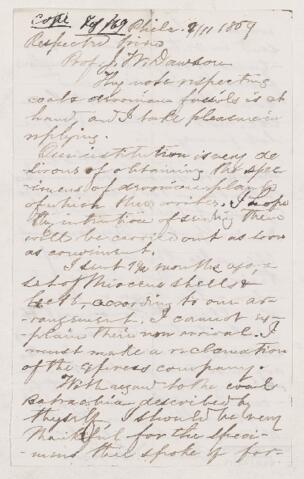
    Letter from E.D. Cope to John William Dawson.

    Notes area

    Physical condition

    Immediate source of acquisition

    Arrangement

    Language of material

      Script of material

        Location of originals

        Availability of other formats

        Restrictions on access

        Terms governing use, reproduction, and publication

        Finding aids

        Associated materials

        Related materials

        Accruals

        Alternative identifier(s)

        Standard number

        Standard number

        Access points

        Subject access points

        Place access points

        Name access points

        Genre access points

        Control area

        Description record identifier

        Institution identifier

        Rules or conventions

        Status

        Level of detail

        Dates of creation, revision and deletion

        Language of description

          Script of description

            Sources

            Digital object (External URI) rights area

            Digital object (Reference) rights area

            Digital object (Thumbnail) rights area

            Accession area