Item 0010 - Letter, 10 December 1881

Open original Digital object

Title and statement of responsibility area

Title proper

Letter, 10 December 1881

General material designation

    Parallel title

    Other title information

    Title statements of responsibility

    Title notes

    • Source of title proper: Title based on content.

    Level of description

    Item

    Reference code

    CA MUA MG 1022-2-1-171-0010

    Edition area

    Edition statement

    Edition statement of responsibility

    Class of material specific details area

    Statement of scale (cartographic)

    Statement of projection (cartographic)

    Statement of coordinates (cartographic)

    Statement of scale (architectural)

    Issuing jurisdiction and denomination (philatelic)

    Dates of creation area

    Date(s)

    • 10 December 1881 (Creation)
      Creator
      Foord, Arthur H. (Arthur Humphrys), 1844-
      Place
      Ottawa (Ont.)

    Physical description area

    Physical description

    Publisher's series area

    Title proper of publisher's series

    Parallel titles of publisher's series

    Other title information of publisher's series

    Statement of responsibility relating to publisher's series

    Numbering within publisher's series

    Note on publisher's series

    Archival description area

    Name of creator

    (1844-1933)

    Biographical history

    Arthur Humphreys Foord was born on September 14, 1844, in Brixton, Surrey, England.

    He was a British paleontologist and scientific illustrator. He attended Chatham House School, Ramsgate, Kent. He worked in a commercial business from 1861 to 1871 and built a reputation as a natural history illustrator. He travelled to Montreal in 1871, with letters of introduction to the first director of the Geological Survey of Canada, Sir William Edmond Logan, Alfred Richard Cecil Selwyn, and to John William Dawson. In 1872, the Geological Survey of Canada appointed Foord as a natural history artist, a position he held until 1883. Though he worked primarily as an artist, he also gained experience in the field collecting and museum curation. From 1875 to 1876 he took courses in zoology and paleontology at McGill University under Dawson. In 1883, he was appointed assistant paleontologist when the Survey moved to Ottawa. He resigned the same year and returned to London where he worked as a volunteer at the British Museum (Natural History) and took up the private study of geology, practical zoology, and comparative anatomy. In 1883, he published "Contribution to the Micro-Palaeontology of the Cambro-Silurian Rocks of Canada", followed by 5 papers on fossil corals in the Annals and Magazine of Natural History and Geological Magazine (1884-1886). Foord was given the responsibility of preparing the “Catalogue of the Fossil Cephalopoda” in the British Museum, seeing the first 2 volumes published in 1888 and 1891, and a third with George Charles Crick published in 1897. In 1888, he was made a fellow of the Geological Society of London. He moved to Dublin in 1891 where he was appointed librarian and editor of scientific publications of the Royal Dublin Society, a position he held until his retirement in 1920. He worked on the cephalopod material in the Geological Survey of Ireland collections and the National Museum of Ireland. In 1896, he was awarded a doctorate from the University of Munich having submitted a thesis which he later published as a 5-volume monograph with the Palaeontographical Society, “Carboniferous Cephalopoda of Ireland" (1897–1903).

    In 1896, he married Ida Franziska Adelheid Kuhlmeyer (1846–1916). He died on August 12, 1933, in Steyning, Sussex, England.

    Custodial history

    Scope and content

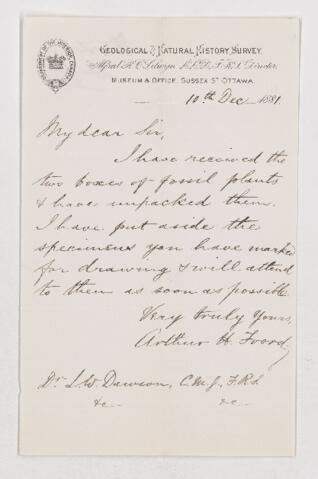
    Letter from A.H. Foord to John William Dawson, written from Ottawa.

    Notes area

    Physical condition

    Immediate source of acquisition

    Arrangement

    Language of material

      Script of material

        Location of originals

        Availability of other formats

        Restrictions on access

        Terms governing use, reproduction, and publication

        Finding aids

        Associated materials

        Related materials

        Accruals

        Alternative identifier(s)

        Standard number

        Standard number

        Access points

        Subject access points

        Place access points

        Name access points

        Genre access points

        Control area

        Description record identifier

        Institution identifier

        Rules or conventions

        Status

        Level of detail

        Dates of creation, revision and deletion

        Language of description

          Script of description

            Sources

            Digital object (External URI) rights area

            Digital object (Reference) rights area

            Digital object (Thumbnail) rights area

            Accession area