
McGill Libraries
McLennan Library Building3459 rue McTavish
Montreal, Quebec
H3A 0C9
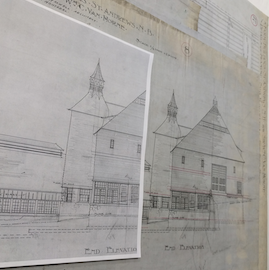
John William Hopkins was born on September 19, 1825, in Liverpool, England.
He studied architecture in England. In 1852, he moved to Montreal where he created a firm with architects James Nelson and Frederick Lawford (Hopkins, Lawford and Nelson, architects). In 1860, he began to practise on his own. He designed the former Customs Building at Pointe-à-Callière (1863) and the Crystal Palace on Victoria Street (1866), both now demolished. In 1869, he joined forces with architect Daniel B. Wily (Hopkins and Wily). Together they designed the Shaw Building (1869), the Exchange-Bank Building (1874), and the Art Association of Montreal's art gallery, which was to become the Montreal Museum of Fine Arts. In 1879, Hopkins' son, Edward C., joined the company and they remained partners until 1896. Their plans included the Waddell Building (1884) and the Montreal-Street-Railway Building (1893-1895). Hopkins was the first president of the Association des Architectes de la Province de Québec in 1890.
In 1852, he married Margaret Elizabeth Tilley. He died on December 11, 1905, in Montreal, Quebec.
Edward Colis Hopkins, son of the prominent Montreal architect John W. Hopkins, was born on January 21, 1857, in Montreal, Quebec.
He trained under his father with whom he formed a partnership in 1879 (J.W. & E.C. Hopkins). He worked in Boston from 1894 to 1896 and in Quebec City from 1896 to 1904 with George E. Tanguay. He designed the ice palace in Montreal for Canada’s Governor-General Marquess of Lorne. Shortly after the death of his father in 1905, Edward moved to Calgary where he became associated with a successful architect William M. Dodd. In 1906, he moved to Edmonton to take up the position of Provincial Architect for Alberta. In 1907, he resigned from this position and became a partner in the firm of Magoon, Hopkins & James. In 1908, their office was called Hopkins & James, and in 1909, Hopkins formed another partnership with Edmund Wright which was dissolved within a year. He started his own practice specializing in the design of large commercial and industrial warehouse buildings. His best-known work is a large block called The Boardwalk, a brusque Romanesque Revival warehouse clad in brick and stone originally built for Ross Brothers Hardware Company. In 1910, he was elected President of the Alberta Association of Architects.
In 1885, he married Emma Jane Blow. He died on August 18, 1941, in Edmonton, Alberta.
"Architectural Drawings, 1856-95, 18 drawings." Included are two drawings of designs by Hopkins, Lawford and Nelson for the Old Post Office in Kingston, ON. Drawings by Hopkins and Hopkins include designs for houses in Montreal and Ste. Anne-de-Bellevue, PQ and drawings of the Harbour Commissioner's Building in Montreal.
"Dessins architecturaux, 1856-1895, 18 dessins." Notamment, deux dessins des plans réalisés par Hopkins, Lawford et Nelson pour le Vieux Bureau de poste de Kingston (Ontario). Au nombre des dessins réalisés par Hopkins et Hopkins, signalons diverses maisons de Montréal et de Sainte-Anne-de-Bellevue (Québec) et des dessins de l'immeuble du Commissaire du havre de Montréal.
English
Lawford and Nelson, CAC 23.03;
Taylor and Gordon, CAC 7
John William Hopkins (1825-1905) was born in Liverpool. He received his architectural training in England and emigrated to Canada in 1852. Upon his arrival in Montreal, Hopkins became a partner of James Nelson (1830-1919). Noteworthy among their projects was the design of the Mechanics' Institute (1854) in Montreal. Later Frederick Lawford joined the firm, which subsequently was renamed Hopkins, Lawford and Nelson. This firm was in operation until 1860. Hopkins then practised architecture on his own until 1893 when his son Edward C. Hopkins (b. 1857) became his partner. The father and son practised together until Edward relocated to Calgary in 1904. The elder Hopkins was the first president of the Province of Quebec Association of Architects, a position that he held from 1890 until 1891.
John William Hopkins (1825-1905) est né à Liverpool. Il a reçu sa formation d'architecte en Angleterre et a émigré au Canada en 1852. À son arrivée à Montréal, Hopkins est devenu l'associé de James Nelson (1830-1919); signalons, au nombre de leurs projets, les plans du Mechanics' Institute (1854) de Montréal. Plus tard, Frederick Lawford s'est joint à ce cabinet qui a par la suite porté le nom de Hopkins, Lawford et Nelson. Ce cabinet a été en exercice jusqu'en 1860. Hopkins a ensuite exercé l'architecture seul jusqu'en 1893, date à laquelle son fils, Edward C. Hopkins (né en 1857) est devenu son associé. Le père et le fils ont exercé ensemble jusqu'à ce qu'Edward parte s'installer à Calgary, en 1904. Hopkins père a été le premier président de l'Association des architectes de la province de Québec, poste qu'il a occupé en 1890 et 1891.