
McGill Libraries
McLennan Library Building3459 rue McTavish
Montreal, Quebec
H3A 0C9
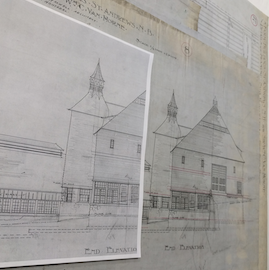
132 architectural drawings
cm of graphic materials and textual records
John Smith Archibald (1872-1934) received his early architectural training in the office of William Maclntosh in his native town of Inverness, Scotland. In 1893 he emigrated to Canada and found employment at the firm of Edward Maxwell (1867-1923) in Montreal, working as a draughtsman and assistant to Maxwell. Archibald stayed at the firm until 1897 when he formed a partnership with another former Maxwell draughtsman, Charles Jewett Saxe (1870-1943). This partnership continued until 1915 at which time Archibald began to practise alone. He designed a variety of structures including a number of stations and hotels for the Canadian National Railway; he designed several sports buildings including the Montreal Forum, a number of schools, churches, commercial buildings, and hospitals, as well as residential buildings in Montreal and Kingston. Noteworthy among his many projects is the Masonic Memorial Temple in Montreal (1928). Upon his death in 1934, Archibald's practice was continued by his son Ian T. Archibald (1903-71) and Hugh Percival Illsley (b.1896). They were later joined by Francis Orr Templeton (1904-72) to form the firm of Archibald, Illsley and Templeton which practised architecture in Montreal until 1950.
John Smith Archibald (1872-1934) reçut ses premiers rudiments de formation en architecture au cabinet de William MacIntosh, dans sa ville natale d'Inverness (Ecosse). En 1893, il émigre au Canada et trouve de l'emploi dans le cabinet d'Edward Maxwell (1867-1923) à Montréal où il est dessinateur et adjoint de Maxwell. Archibald quitte ce cabinet en 1897 et s'associe à un autre dessinateur de Maxwell, Charles Jewett Saxe (1870-1943), association qui se maintient jusqu'en 1915. Par la suite, Archibald poursuivit sa carrière seul. Archibald a dessiné un grand nombre de structures et notamment des gares et des hôtels pour la société Canadien National; il a également dessiné plusieurs immeubles à vocation sportive dont le Forum de Montréal, bon nombre d'écoles, des églises, des immeubles commerciaux et des hôpitaux, de même que des immeubles résidentiels à Montréal et à Kingston. Signalons, parmi ses multiples projets, le Temple maçonnique de Montréal (1928). À son décès en 1934, le cabinet d'Archibald fut repris par son fils lan T. Archibald (1903-1971) et par Hugh Percival Illsley (né en 1896). Quelque temps plus tard, Francis Orr Templeton (1904-1972) se joignit à eux pour former le cabinet d'Archibald, Illsley et Templeton qui a pratiqué l'architecture à Montréal jusqu'en 1950.
Hugh Percival Illsley gave the collection to the CAC circa 1976.
Le matériel a été remis à la CAC par Hugh Percival Illsley en 1976.
Architectural drawings documenting ten projects of the practice of the Montreal architect John Smith Archibald are found in this subfonds along with photographs and postcards assembled by Archibald and his associates.
Includes:
"Architectural Drawings, 1917-30, 132 drawings." Ten projects are represented in this archive including additions and alterations to the Chateau Laurier Hotel in Ottawa, Queen's University Athletic Building in Kingston, ON and Montreal buildings such as the Masonic Temple, the Ecole Technique de Montreal and the Windsor Hotel.
"Photographs, n.d." Photographs of Italian and French architecture including interiors, exteriors, and details, a photograph of a R.C.M.P. Garage in Montreal, and photographs of American public buildings assembled by Archibald and his associates, are found in the archive.
"Postcards, n.d." Included is a collection of postcards illustrating Italian and French architecture (exteriors, interiors, and details of buildings) assembled by Archibald and his associates.
La collection comprend des dessins architecturaux témoignant de dix projets réalisés à Montréal par l'architecte John Smith Archibald ainsi que des photographies et des cartes postales réunies par Archibald et ses associés:
"Dessins architecturaux, 1917-1930, 52 dessins." Dix projets sont représentés dans le fonds, notamment des annexes et modifications à l'hôtel Château Laurier d'Ottawa, le Queen's University Athletic Building de Kingston (Ontario) et divers immeubles montréalais comme le Temple maçonnique, l'École technique de Montréal et l'hôtel Windsor.
"Photographies, s.d." Des photos d'architecture italienne et française, notamment des intérieurs, des extérieurs et des détails, une photo d'un garage de la GRC à Montréal et des photos d'immeubles gouvernementaux des États-Unis réunies par Archibald et ses associés.
"Cartes postales, s.d." Une collection de cartes postales illustrant des oeuvres d'architecture italienne et française (extérieurs, intérieurs et détails des immeubles) réunie par Archibald et ses associés.
English
For further information, see the CAC's publication, John S. Archibald and His Associates: A Guide to the Archive=John S. Archibald et ses associés: Guide du fonds. Montreal: Canadian Architecture Collection, Blackader-Lauterman Library of Architecture and Art, McGill University, 1990. Also see Irene Puchalski. An Analysis of Four Building Types by John S. Archibald, Architect (1872-1934). M.A. Thesis. Montreal: Concordia University, 1991.
Pour plus de renseignements, veuillez consulter la publication de la CAC intitulée John S. Archibald and Ris Associates: A Guide to the Archive = John S. Archibald et ses associés: Guide du fonds. Montréal : Collection d'architecture canadienne, Bibliothèque Blackader-Lauterman d'architecture et d'art, Université McGill, 1990. Voir aussi Irene Puchalski. An Analysis of Four Building Types by John S. Archibald, Architect (1872-1934). Thèse de maîtrise. Montréal: Université Concordia, 1991.
Please note that description is ongoing and records are currently being updated.