
Collection MSG 1089 - John Colborne Collection

Title and statement of responsibility area

Title proper

John Colborne Collection

General material designation

    Parallel title

    Other title information

    Title statements of responsibility

    Title notes

    Level of description

    Collection

    Reference code

    CA RBD MSG 1089

    Edition area

    Edition statement

    Edition statement of responsibility

    Class of material specific details area

    Statement of scale (cartographic)

    Statement of projection (cartographic)

    Statement of coordinates (cartographic)

    Statement of scale (architectural)

    Issuing jurisdiction and denomination (philatelic)

    Dates of creation area

    Date(s)

    • 1837-1838 (Creation)
      Creator
      Colborne, John, Sir, 1778-1863

    Physical description area

    Physical description

    1 cm of textual records

    Publisher's series area

    Title proper of publisher's series

    Parallel titles of publisher's series

    Other title information of publisher's series

    Statement of responsibility relating to publisher's series

    Numbering within publisher's series

    Note on publisher's series

    Archival description area

    Name of creator

    (1778-1863)

    Biographical history

    John Colborne was born on January 16, 1778, in Lymington, England and died on April 17, 1863, in Torquay, England. He was the only son of Samuel Colborne Cordelia Anne Garstin. In 1813, Colborne married Elizabeth Yonge, they had three daughters and five sons. He was educated at Christ’s Hospital in London and at Winchester College. Colborne was commissioned as an ensign in the 20th Regiment of Foot in 1794, was promoted to lieutenant in 1795, and then to captain lieutenant in 1799, where he was wounded during the Anglo-Russian invasion of Holland. In 1806, he was deployed with his regiment to Italy, where he fought at the Battle of Maida in July during the War of the Third Coalition. Colborne became military secretary to General Henry Fox that same year and then became military secretary to Sir John Moore with the rank of major in 1808. He served Moore at the Battle of Benavente, the Battle of Corunna, the Battle of Ocaña, and the Battle of Bussaco in Portugal. Colborne then went on to become commander-in-chief of all the armed forces in British North America, leading the offensive at the Battle of Saint-Eustache in Lower Canada and defeating the rebel force in 1837. In 1828, he was appointed Lieutenant Governor of Upper Canada. One year later, Colborne founded Upper Canada College. In 1839, he left Canada and was elevated to the peerage as Baron Seaton, of Seaton in the County of Devon. Colborne became High Commissioner of the Ionian Islands in 1843 and then Commander-in-Chief, Ireland, in 1855. In 1866, a bronze statue sculpted by George Adams was erected at Mount Wise in Devonport, then moved to Seaton Barracks in Crownhill in the early 1960s, and then to Peninsula Barracks in Winchester in the 1990s. A second statue of Colborne was erected at Upper Canada College in Toronto. Colborne Street in London, Ontario is named after him, along with the city of Port Colborne in Ontario.

    Custodial history

    Scope and content

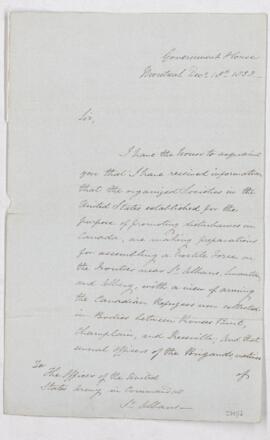
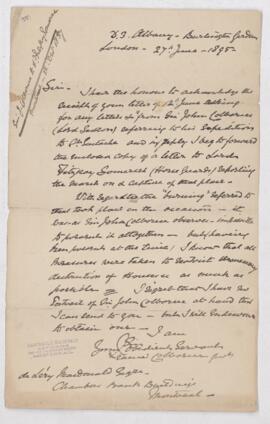
    Three letters from Seaton relating to the Rebellion of 1837, including a letter to General Fitzroy Sommerset about the capture of St-Eustache.

    Notes area

    Physical condition

    Immediate source of acquisition

    Arrangement

    Language of material

      Script of material

        Location of originals

        Availability of other formats

        Restrictions on access

        Terms governing use, reproduction, and publication

        Finding aids

        Also described in the McGill Libraries catalogue.

        Associated materials

        Related materials

        Accruals

        General note

        Originals

        Alternative identifier(s)

        Legacy call number

        CH73,S91, CH192.S170, CH91.S109

        Standard number

        Standard number

        Access points

        Place access points

        Name access points

        Genre access points

        Control area

        Description record identifier

        Institution identifier

        Rules or conventions

        Status

        Level of detail

        Dates of creation, revision and deletion

        Language of description

          Script of description

            Sources

            Accession area