
McGill Libraries
McLennan Library Building3459 rue McTavish
Montreal, Quebec
H3A 0C9
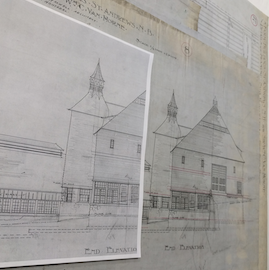
Jerry Miller (OAQ, OAA, FRAIC) studied architecture at McGill University where he received a B.Arch in 1957, and at Harvard University where he received an M. Arch, Urban Design in 1963. Since the 1960s his work has included the design and implementation of the master plan for Expo '67, the design and construction of Churchill Falls townsite, Universite de Laval(1966) and King Abdul Aziz University, Jeddah, Saudi Arabi,a (1973-1978) master plans, University of Ottawa Health Sciences Complex (1984), and McGill University Sports Complex (1993).
Mr. Miller also had special interest and experience in healthcare projects in Quebec and Ontario particularly in relation to long-term care for the elderly, and the humanization of the hospital environment.
The architectural material was donated to the John Bland Canadian Architecture Collection in 2004 and 2005 by Jerry Miller, Senior Partner, Fiset Miller Bourke Architectes.
The Jerry Miller Fonds is comprised of architectural drawings for the Churchill Falls Townsite in central Labrador, the restoration and conversion of several historic buildings in Montreal, a coast guard complex in Sorel, a residence for La Communauté des Soeurs de Charité de la Providence in Boucherville and the Canadian Embassy in Paris.
The design and construction of the new town of Churchill Falls was a $25 million project which included housing for 1500 permanent inhabitants grouped around a multi-use town centre comprising a school, hotel, commercial centre, gym, swimming pool, and other recreational facilities, all organized around a skylit interior concourse.
Construction of the permanent all-electrical community especially designed for northern living began in 1968. The new community marked a milestone in the ability of Canadians to adapt to northern conditions. It housed the permanent operating and maintenance staff of the huge Churchill Falls hydro-electric power development which was under construction a mile east of the townsite.
Adjoining a temporary trailer town for the families of construction personnel and the main construction camp for the hydro development, the town centre was built to serve the families in the temporary town and to supplement facilities in the main construction camp, as well as to serve the first permanent residents. The permanent and the temporary facilites were to function together as one community during the hydro project's construction. When the Churchill Falls development was completed, the temporary town and the construction camp remained as service areas into which the permanent community of more than 1000 residents grew in accordance with an overall master plan.
The availability of abundant and reliable hydro power offered unusual opportunities in planning the new community. Electricity was used for everything from keeping water mains from freezing to climate control of the town centre and heating of all dwellings.
Experience had shown that people living in relatively small, isolated centres who are in daily contact at work, want and need privacy in their homes. The Churchill Falls facilities were planned to bring residents together where community activity is concerned but to respect the need for domestic privacy. Great attention was also paid to accoustical details in the houses because of the effects of this noiseless environment. The notion of residents moving out-of-doors from home to town centre facilities was thought to reduce the senses of isolation and confinement.
Housing is divided between the multiple unit dwellings south of the town centre and single houses north of it. Five models of single family dwellings were built in the first year. A competition was held for the design of executive houses. Apartment buildings are two storeys with a basement. Garages are housed in separate structures as close to the street as possible to reduce snow shovelling.
Although the community was compact enough for residents to walk everywhere, planners acknowledged that the automobile was an essential accessory to most people so they provided for its use at Churchill Falls.
Open spaces were left every few houses for public play areas and as access ways between blocks from one street to the next. Lots are about 50 feet wide and running 130 to 140 feet deep to the next street.
The plans for the new community were originally prepared by Fiset Deschamps, architects and townplanners of Montreal and Quebec, in association with Beauchemin Beaton Lapointe, consulting engineers of Montreal, and Gorman Butler Associates Ltd., consulting engineers and architects of St. John's.
"New Town for Churchill Falls," Community Planning Review 18, no. 1 (1968): 18-21.
Drawings sheets for Churchill Falls bear the names of various creators in relation to the long history of the firm. Dates and named creators have been included in the description of the fonds in order to link the architects with specific stages of the project.
English
File list:
"Churchill Falls Townsite",
Architectural Drawings, 1965, 1967-69, 1971-74, 1976-79, 807 drawing sheets. Drawings range in size from 18 x 31 cm to 85 x 125 cm."
"Site plans"
"Master Plan", 1972, Fiset Deschamps, Fiset Deschamps Papanek
"Landscape", n.d., Robert G. Calvert landscape architect, Fiset Deschamps
"Housing", 1971-73, Fiset Deschamps Papanek
"Housing", 1971-72, Fiset Deschamps Papanek
"Housing-Management Houses", 1972-73, Fiset Deschamps Papanek
"Housing-Executive Houses", 1972, Fiset Deschamps, Fiset Deschamps Papanek
"Housing-Apartment Blocks 1974", Fiset Papanek Miller
"Church", 1971, Fiset Deschamps Papanek
"School, School Extension, Conversion of ACB/CFLCO offices to High School", 1968, 1973, 1976, 1977, Fiset Deschamps Papanek, Fiset Deschamps, Fiset Miller Vinois
"Hockey Arena", 1978-79, Fiset Miller Vinois Warren and Associates
"Control and Administration Building and Extension, 1973-74," Fiset Deschamps Papanek
"Town Centre: gymnasium, curling, field, hotel, store, cold room, truck dock", 1967, 1968, n.d., Eduard Fiset, Fiset Deschamps, Parkin Architects
"Churchill Falls Community Facilities," Graphics
"Town Center Complex," 1978, Fiset Miller Vinois
"Town Center Complex," 1968, Fiset Miller Vinois, Deschamps Fiset
"Control and Administration Building," 1973, Fiset Papanek Deschamps Architects, Jerry Miller Associate Architect [building expansion for permanent staff in lightweight, economical construction]
"Bell Canada 87 rue Ontario, Montreal," 1987, Fiset Miller.
30 construction drawings and 8 copies of drawings for the original building designed in 1915.<br> The work by Fiset Miller was a complete restoration of the envelope including new windows with special extrusions to match original profiles, several different cleaning and repair techniques for restoring the masonary facades, and the rebuilding of the cantilevered 6.5 foot cornice in copper.
"Renovation to the Base Facility at Sorel"
Transport Canada, Coast Guard, Sorel, QC
1984, 85, 87, Fiset Miller Vinois
30 constructions drawings and isometrics.
The complex includes facilities for the maintenance of winter and summer buoys in the St. Lawrence River, search and rescue, and maritime emergency.
"Chancellerie Ambassade du Canada,Paris, France"
1977-1982, Fiset Miller Vinois
22 presentation drawings, 53 construction drawings, 1 exterior photograph, and 8 negatives of drawings for the original building.
[For security reasons, there is restricted access to this material. Please contact the Curator for details.]
"Résidence Boucherville"
La Communauté des Soeurs de Charité de la Providence
Province St-Vincent-de-Paul, Boucherville, QC
1974-75, Fiset Papanek Miller
2 presentation drawings, 17 construction drawings
A residence for 125 aged and 25 caregiving sisters, it is designed in clusters for 25 residents, each with their own facilities, solarium and outdoor terrace. A walking path within the building leads to a chapel, an inner courtyard, cafeteria, and other community ammenities.
"La Brasserie Molson du Québec, Ltee, Salle de Reception"
1670 est rue Notre Dame, Montreal
1985, Fiset Miller Vinois
1 presentation drawing, 42 construction drawings, and 6 detail drawings
The historic Molson Building designed in 1907, was transformed into a reception entertainment facility.