
McGill Libraries
McLennan Library Building3459 rue McTavish
Montreal, Quebec
H3A 0C9
Henry Saxon Snell (1831-1904) worked in the offices of Sir James Pennethorne, Sir Joseph Paxton and Sir William Tite. In 1851 he won the Royal Academy Silver Medal for his measured drawings of St. Mary-le-Bow, Cheapside. About 1866 he was appointed architect to the St.Marylebone Board of Guardians, beginning the reconstruction of the Marylebone Workhouse.He became a member of the Architectural Association in 1850 and was elected a Fellow of the Royal Institute of British Architects in 1873. Among his principal architectural works were the Boys’ School for the Royal Patriotic Fund, Wandsworth; the Convalescent Home for Children, Norbiton; the Holorn Union Infirmary, Highgate Hill; St. Olave’s Tooly Street Union Infirmary, St. George’s Hanover Square, Union Infirmary; Casual Wards, Marylbone Workhouse; Marylbone Swimming Baths; Infirm Wards and administrative offices for St. Luke’s Workhouse in City Road and Shepherdess Walk.
In 1887 his designs were adopted for a conversion of the front main building of the Aberdeen Royal Infirmary for administrative and clinical purposes only, and for the removal of all the patients into new pavilions at the rear. He was architect jointly with Mr. Alfred Williams, of the Kensington Infirmary, and assisted Capt. Fowke, R.E., on the Dublin Exhibition.
Henry Saxon Snell was afterwards in partnership with his son, Alfred Saxon Snell, under the name of H. Saxon Snell and Son, and carried out extensive works for various Metropolitan Boards of Guardians. He retired in 1897. Under the terms of his will, the sum of £750 was given to the Royal Institute of British Architects for the institution and maintenance of a special triennial Scholarship. Among his publications are Charitable and Parochial Institutions (London: B.T. Batsford, 1881) and Hospital Construction and Management (London: Churchill,1883).
In September 1887,the name of the British architect Henry Saxon Snell (1831-1904) was mentioned by the founders of the RVH as a suitable architect for the project. On December 22, 1887 it was decided to employ Saxon Snell for the preparation of the plans, specifications and working drawings of the hospital. He visited Montreal for the first time in the winter of 1888 bringing with him sketch plans for a proposed hospital. The plans were the subject of much protest because of the size of the buildings. After the change of site for the hospital to University Street, he returned to Montreal in the spring of 1889 with new plans. The final plans showed many changes in the layout, in the staff accommodation, the size of the Out-Patient Department, and in operating room facilities.
Royal Victoria Hospital
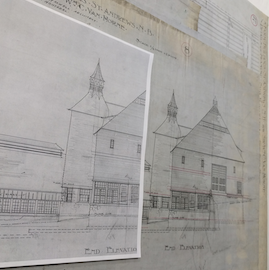
Fonds consists of architectural drawings of the Royal Victoria Hospital in Montreal, Quebec, dating from 1889-1892. Also included are drawings of Ross Memorial and other later additions (1914, 1916). Drawings are in various combinations of pen and blue and black ink; brown, pink, green, blue, coloured pencils, and graphite, most laid down on board, with many on linen laid down on board, some on paper laid down on board, one on linen, one on paper. All are working drawings and include plans, elevations, sections and details. 66 drawings comprise a group of working drawings for the Royal Victoria Hospital, Montreal. The Administrative Building, Surgical Theatre, Medical Theatre, West Wing, Eastern Pavilion and Power Plant, are the main areas of concentration. Drawings for the Administration Building include the earliest floor plans, a full set of floor plans before it was reduced, including “Plan of Ground Floor or Principal Entrance Floor” which has a ‘tack on drawing’, and a complete set of plans and sections for the smaller Administration Building, signed off.
Drawings were encapsulated in mylar sometime after 1999.
Physical arrangement of the drawings in their mylar encapsulation does not reflect any original intellectual arrangement.
English