
McGill Libraries
McLennan Library Building3459 rue McTavish
Montreal, Quebec
H3A 0C9
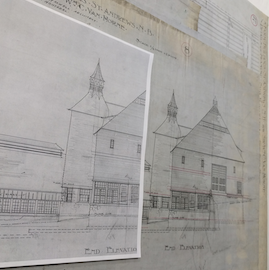
McGill graduate Harold Featherstonhaugh became an architect renowned for such Montreal landmarks as the Church of St. Peter and St. Paul and the Birks building which now houses the McGill Faculty of Religious Studies. He was a lieutenant in the Artillery Field Regiment before World War I; he then served in the 39th Battery during the war and was awarded the Military Cross in 1917. Earlier, he had worked with Edward and William Sutherland Maxwell, then in 1923 after the war, he became a partner in an architectural firm with J.C. McDougall; in 1934 he began working on his own until 1955.
Michael Ellwood gave the architectural drawings to the CAC.
Michael Ellwood a remis les dessins architecturaux à la CAC.
"Architectural Drawings, 1929-30, 17 drawings." Drawings of elevations, sections and details document the design of Divinity Hall, now known as the William and Henry Birks Building of McGill University.
"Oil Painting, n.d. " An untitled, undated framed oil painting of an unidentified tropical harbour scene is found in the collection.
"Dessins architecturaux, 1929-1930, 17 dessins." Des dessins d'élévations, de coupes et de détails se rapportant aux plans du pavillon William and Henry Birks réalisé pour l'Université McGill.
"Tableau à l'huile, s.d., 1 tableau." Un tableau à l'huile, sans titre, sans date, encadré, représentant un port des tropiques non identifié s'ajoute à la collection.
English
Fetherstonhaugh and Durnford, CAC 11.03;
Fetherstonhaugh, Durnford, Bolton and Chadwick, CAC 11.04
Harold Lea Fetherstonhaugh (1887-1971) was born in Montreal. He graduated from McGill University with a degree in architecture in 1909. The years of 1910 to 1911 were spent working for architecture firms in New York and Montreal. From 1911 to 1913 he travelled abroad and continued his architectural education by studying in the Atelier Laloux in France. During the First World War Fetherstonhaugh served in the Canadian Field Artillery. After the war he established an architectural practice in Montreal. Residential commissions dominate his oeuvre, however, he had a number of notable commissions for public buildings, in particular for McGill University. Fetherstonhaugh received a medal from the Royal Architecture Institute of Canada for his design for the Douglas Hall men's residence, and he designed Divinity Hall on University Street, now called the William and Henry Birks Building, which houses the Faculty of Religious Studies. Fetherstonhaugh was the president of the Royal Architecture Institute of Canada from 1928 to 1939 and he served as the president of the Province of Quebec Association of Architects.
Harold Lea Fetherstonhaugh (l887-197 1) est né à Montréal. Il a reçu en 1909 son diplôme d'architecture de l'Université McGill. En 19 10 et 1911, il a travaillé pour des cabinets d'architecture à New York et à Montréal. De 1911 à 1913, il a voyagé à l'étranger et a poursuivi sa formation en étudiant à l'Atelier Laloux de Paris. Pendant la Première Guerre mondiale, Fetherstonhaugh est entré dans les rangs de l'Artillerie canadienne de campagne. Après la guerre, il a ouvert son propre cabinet à Montréal. Il a surtout réalisé des immeubles résidentiels, mais quelques immeubles publics sont à signaler, en particulier ceux qu'il a réalisés pour le compte de l'Université McGill. Fetherstonhaugh. a reçu une médaille de l'Institut royal d'architecture du Canada pour sa conception du Douglas Hall, la résidence des étudiants. Il a également dessiné Divinity Hall, rue University, qui porte aujourd'hui le nom de pavillon William and Henry Birks où logent les Études religieuses. Fetherstonhaugh a été président de l'Institut royal d'architecture du Canada de 1928 à 1939 et a été président de l'Association des architectes de la province de Québec.