
McGill Libraries
McLennan Library Building3459 rue McTavish
Montreal, Quebec
H3A 0C9
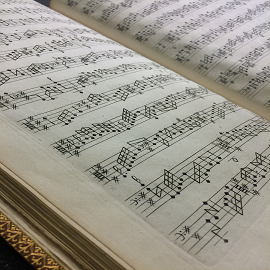
Native Montrealer Jerry Renewych began his career in music publishing with a degree in classical music and piano from McGill University and also attended the Royal Conservatory of Music in Toronto. Born to Ukrainian immigrant parents in 1940, and baptized Yaroslas Bohdan Hrynewych, he seems to have decided to call himself Jerry Renewych as an adult. By 1967, he was working for Southern Music Company in Montreal, having written a few songs as “Jerry” Hrynewych and “J.B.” Hrynewych during the early 1960s. He became professional manager for the Canadian branch of Chappell, a music company, and moved to Toronto around 1972 as its general manager. During the 1970s, under the pseudonym “Bob Bilyk” (his grandmother’s maiden name), he partnered with Martin Butler as a song-writing team. The two wrote songs for Les Sceptres, Trini Lopez, and Ginette Reno, among others. One of the better known was “We Gotta Make It Together.” In 1980 he became a director of the Composers, Authors and Publishers’ Association of Canada and, in 1984, vice president of the Canadian Music Publishers Association. Chappell became part of the international entertainment conglomerate Polygram Group, which sold it to Warner Communications Inc. in 1987. The name was changed to Warner/Chappell Music Canada Ltd., and in 1992 Renewych became president. During the 19 years he held that post, he secured over 300 cover versions of works by his song-writing team. During this time, he was also on the boards of directors of several smaller music companies, including Felsted Music of Canada, Edwin H. Morris (Canada) Ltd., Burlington Music of Canada Ltd., Farrell Yangaroo Inc. and Intersong Belinda Canada Ltd. In 1997 he opened his own company, Golden Phoenix.
Canadian pianist and songwriter Bill Diachun was born in Montreal, Quebec, the second child of Ukrainian immigrants. He attended McGill University’s MacDonald College in the West Island, and was a quarterback on the football team; he also played Rugby with the NDG Maple Leafs. As a student, he also accompanied singers at collegiate variety shows. In 1964 he and fellow Ukrainian Montrealer Jerry Hrynewych co-wrote the song “Swing High, Freedom Chariot.” Shortly after his daughter was born the family moved to Annapolis, Nova Scotia, where Diachun taught school in nearby Digby, but later moved back to Montreal. He taught high-school English in the Montreal area, but on the side followed his musical inclinations, composing and singing such songs as “Gypsy Lover” (1971), “Walk the Straight and Narrow”(1971), and “Mon Dieu, écoute ma prière.” His daughter, Melody, became a jazz singer and composer, and in 2009 was a Canadian National Jazz Awards' nominee for Female Vocalist of the Year in 2009.