
McGill Libraries
McLennan Library Building3459 rue McTavish
Montreal, Quebec
H3A 0C9

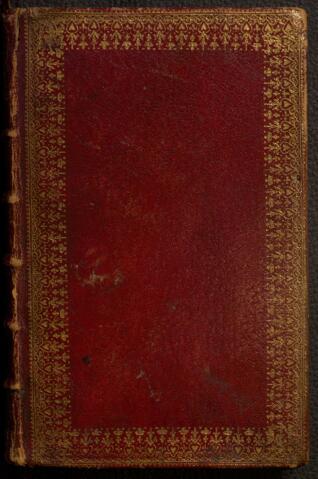
1 volume ; 20 x 13 cm (octavo)
Frances Burney, also known as Fanny Burney and later Madame d'Arblay was born on June 13, 1752, in Lynn Regis, England, to the musician Dr. Charles Burney (1726–1814) and his first wife, Esther Sleepe Burney (1725–1762).
She was an English satirical novelist, diarist, and playwright. She began composing small letters and stories almost soon after learning the alphabet. She often joined her brothers and sisters in writing and acting in plays. She educated herself by reading from the family collection, including Plutarch's Lives, works by Shakespeare, histories, sermons, poetry, plays, novels, and courtesy books. A Burney family friend, the "cultivated littérateur" Samuel Crisp, encouraged Burney's writing by soliciting frequent journal letters from her that recounted to him the lives of her family members and social circle in London. The first entry in Frances Burney's journal was dated March 27, 1768, and addressed to "Nobody." The journal itself was to extend over 72 years. A talented storyteller with a strong sense of character, Burney kept the journal diary as a form of correspondence with family and friends, recounting her observations about life events. Burney's Evelina, or the History of a Young Lady's Entrance into the World, was published anonymously in 1778. The novel was a critical success (four immediate editions) and admired for its comic view of wealthy English society and realistic portrayal of working-class London dialects. In 1779, she published a satirical comedy, The Witlings, followed by Cecilia, or Memoirs of an Heiress, in 1782. In 1786, she accepted the post "Keeper of the Robes" offered by the Queen, with a salary of £200 per annum. After the French Revolution began in 1789, Burney was among many literary figures in England who sympathized with its early ideals of equality and social justice. She became close to General Alexandre d'Arblay (1748-1818), an artillery officer and a hero of the French Revolution. Despite Burney's father disapproving of d'Arblay's poverty, Catholicism, and ambiguous social status as an émigré, they married in 1793 and had a son, Alexander Charles Louis (1794-1837). She continued writing, e.g., Camilla, or a Picture of Youth (1796), Love and Fashion, A Busy Day, and The Woman Hater (1797-1801). In 1811, she underwent a mastectomy due to breast cancer. In 1814, she published the novel The Wanderer: Or, Female Difficulties, set in the French Revolution, criticizing the English treatment of foreigners in the war years. In homage to her father, she published three volumes of the Memoirs of Doctor Burney in 1832. In 2002, the Burney Society of North America and the Burney Society UK unveiled a memorial panel in the new Poets' Corner window in Westminster Abbey in memory of Frances Burney.
She died on January 6, 1840, in Bath, England.
Signature in pencil on endpaper, "C. L. Schreiber," likely indicative that the notebook was given to her by Barrett; sold at Sotheby's by unnamed consignor, 22 July 1980, lot 474.
Autograph manuscript in French containing drafts of approximately 40 letters written upon themes or as writing exercises. Each letter contains corrections by means of footnotes in the lower margin, likely in the hand of Burney's husband, Alexandre d'Arblay. Forty-eight leaves are filled with letter drafts. The rest of the volume is blank until the final two leaves at the end, which are written upside down. These final leaves contain various recipes in French, including "Pour guérir la manie" and "Remède contre l'esquinancie." Volume also includes an additional portion of a theme in Burney's hand on a small sheet tipped in on the front flyleaf. Written in an 18th-century notebook bound in full red morocco, gilt-stamped floral border and spine, with five raised spine bands and spine label: "Almanac de 1736." Notebook has floral gilt and painted endpapers and gold edges.
Purchased from Bloomsbury Auctions, Paula Peyraud Sale, Lot 202 (New York, 6 May 2009). Purchased with Breslauer Foundation finds.
French
Bloomsbury Auctions, The Paula Peyraud Collection: Samuel Johnson & Women Writers in Georgian Society, Sale NY029, Lot 202, page 128.