
Built projects

Elements area

Taxonomy

Code

Scope note(s)

  • For use in CAC fonds and collections, for executed architectural projects.

Source note(s)

  • Art & Architecture Thesaurus

Display note(s)

    Hierarchical terms

    Built projects

      Equivalent terms

      Built projects

        Associated terms

        Built projects

          3 Archival description results for Built projects

          3 results directly related Exclude narrower terms
          CA CAC 58-1-xx · Subseries · between 2005 and 2011
          Part of Moshe Safdie

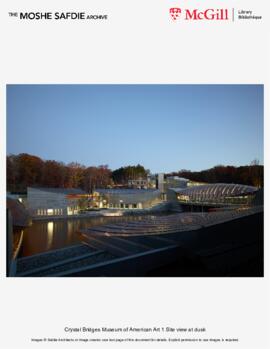
          Crystal Bridges, both a museum and a cultural center, is located in a ravine with a creek fed by Crystal Springs. Two suspended-cable-and-wood buildings span the ravine, creating two ponds. These structures serve as dams as well as bridges.

          The design protects the natural beauty of the site and emphasizes a strong sense of place, employing indigenous materials such as wood, fieldstone, and limestone aggregate. Building walls are concrete with wood inlays, and laminated wood beams compose the roofs. The liberal use of glass throughout the complex provides transparency and enhances views of the site.

          The museum comprises a number of independent structures that form a series of pavilions over and alongside the ponds. The two bridge buildings are located at opposite ends of the north pond. The gallery bridge contains galleries while the entry bridge houses reception, dining, and hospitality facilities. The great hall, a multipurpose public space, is surrounded on three sides by the south pond. Additional structures, nestled into the sloping terrain on both sides of the ravine, contain galleries, function rooms, classrooms, a library, curatorial spaces, and administrative offices. In contrast to the convex roofs of the bridges, the concave roofs of these structures visually retain the steep slopes of the site.

          Safdie Architects
          CA CAC 58-1-557 · Subseries · 1980 - 2015
          Part of Moshe Safdie

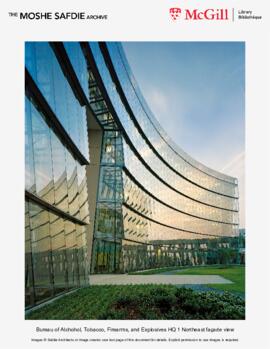
          The Alcohol, Tobacco, Firearms, and Explosives building serves as the national headquarters for a government agency with the highest security requirements. Located at the intersection of New York and Florida avenues, this building has been a catalyst for urban renewal and rejuvenation in the surrounding district. The program called for general office space, extensive training facilities, an auditorium, and auxiliary services.

          Notwithstanding security setback requirements, the complex engages and animates the surrounding street edges. The entrance is positioned across from the new Metro station on the southeast corner; retail facilities line 2nd Street (to the east); and a trellised garden wall defines N Street (to the south). In addition a three-story planted, arcaded crescent contains the site to the north and west, enclosing a 48,500-square-foot internal garden and inconspicuously serving as a security barrier.

          Auxiliary elements such as loading docks and an inspection booth are integrated into the overall fabric of buildings and garden walls. The provision of a technical subfloor for the distribution of data and mechanical services allows for maximum flexibility. The office space consists of relatively narrow floor plates surrounding a large atrium, thus affording daylight for all workspaces.

          Safdie Architects
          CA CAC 58-1-xx · Subseries · between 2011 and 2015
          Part of Moshe Safdie

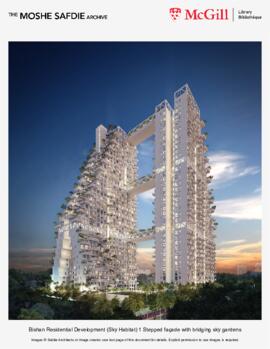
          Located in the neighborhood of Bishan, a residential area in the suburban heartland of Singapore, this 38-story residential complex explores the balance of high-density living with humanistic concepts of community, landscape, gardens, and daylight.

          Breaking down the scale of typical singular tower residential development, the community-based solution of Sky Habitat is a three-dimensional matrix of homes with private terraces, balconies, and common gardens, bringing landscape into the air and maintaining porosity on the skyline. The complex's strong stepped form recalls the community texture of ancient hillside developments and provides for lush vertical greenery, multiple orientations relative to the sun, naturally ventilated units, and generous views, all without compromising planning or structural efficiency.

          Three bridging sky gardens link the two stepping towers and create a series of interconnected streets, gardens, and terraces in the air, which provide a variety of areas for common recreation and congregation. As a result, the overall mass is porous and open, allowing breezes to flow through and daylight to penetrate deep into the structure. The stepping geometry allows every residence multiple orientations and a private outdoor space, resulting in a more humane and delicate urban fabric.

          At the ground plane, above a sunken parking podium, more than 70 percent of the site is developed into a series of lush gardens, which offer additional outdoor event areas, swimming pools, a tennis court, and walking paths.

          Safdie Architects